11 days later, he’s back. Nvidia just rehired Jensen Huang.
Nvidia’s board brought its founder back as CEO this morning, less than two weeks after he resigned amid reports that included a suspected Chinese spy. The stock opened about 30% higher. The investigations are still open.
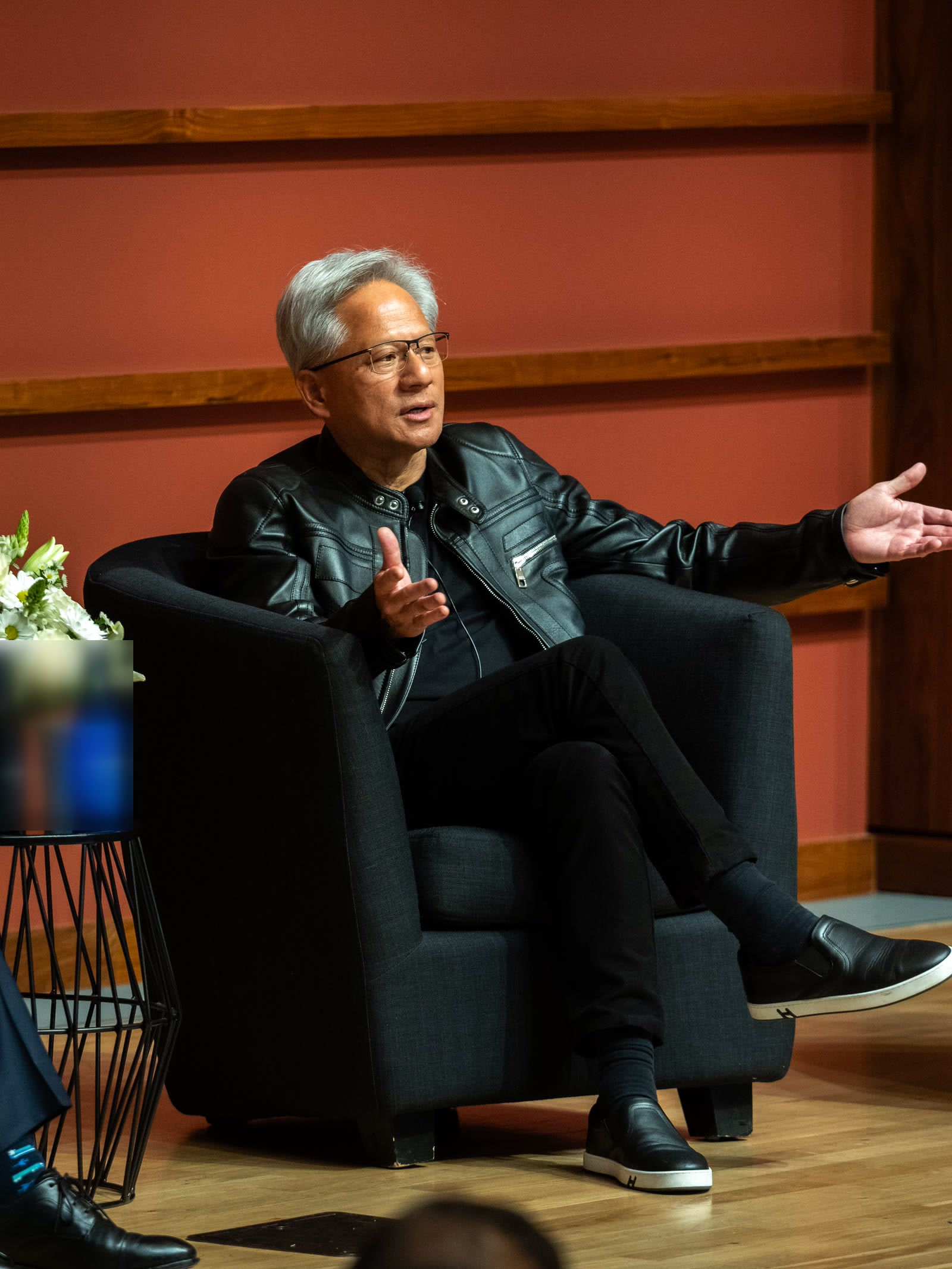
Eleven days. That’s how long Nvidia, the company that makes the chips nearly every big tech company is lining up to buy, went without the man in the black leather jacket.
This morning, Monday, Nov. 23, Nvidia’s board voted unanimously to bring Jensen Huang back as president and CEO and to put him back on the board, “effective immediately,” according to the company’s filing with the SEC. The stock opened roughly 30% higher, TechCrunch reported.
“I am honored to return to NVIDIA and lead one of the most consequential technology companies in the world at the beginning of a new industrial revolution,” Huang said in the company’s statement. He also said, “I can’t wait to get back to work.”
How we got here
Huang resigned on Nov. 12, and the reporting behind it moved fast. CBS News reported that he had an affair with a woman U.S. intelligence agencies suspected of spying for China, and, citing The New York Times, an affair with a subordinate at Nvidia. TechCrunch reported that Huang admitted to at least two extramarital affairs.
What’s confirmed and what isn’t matters here. China has denied the spying claims, CBS reported. Nvidia’s own statement doesn’t confirm or deny them. It refers to “recent reporting that Mr. Huang has been the target of a foreign intelligence effort,” which is not the same as saying he helped one. Huang has not been charged with anything.
While he was gone, chief financial officer Colette Kress stepped in as interim CEO and kept her finance job too.
“Does not intend to reinstate”
Here’s the part that makes today so strange. On Nvidia’s earnings call last week, board chair Harvey Jones said the company “does not intend to reinstate Jensen as CEO,” CBS reported. According to TechCrunch, Nvidia had already hired the executive search firm Heidrick & Struggles to find his replacement.
Outside the boardroom, people did what people do now: they started a petition. It passed 180,000 signatures within days, Al Jazeera reported, and Elon Musk signed it. TechCrunch named other signers, including Epic Games CEO Tim Sweeney, Uber co-founder Travis Kalanick and Y Combinator CEO Garry Tan.
Huang left the door open himself. Last week he said that if the “board of directors decides that my return is in the best interest of our shareholders, our employees, the company and America, I would be honored to answer these calls and return as CEO.”
The president called in
Then the White House got involved. President Trump said he spoke directly to Nvidia’s board, and he told CNBC he was “represented in the board meeting” and that his intervention mattered, Al Jazeera reported. A week earlier, asked about Huang coming back, he had said, “I would not mind seeing that.”
After the announcement, he posted on Truth Social: “The NVIDIA Board of Directors has made the correct and proper decision to return Jensen Huang to the position of CEO.” He added, “The United States Government has no reason to believe that Jensen’s return to NVIDIA poses any risk to National Security.” Trump also said the attorney general had confirmed there is no evidence Huang did anything illegal, TechCrunch reported. That claim comes from the president. We haven’t seen a Justice Department statement saying it.
The board’s statement makes the same point in its own words. It says it “received input from senior levels of the United States government,” and based on that input it is “confident that Mr. Huang’s reinstatement poses no national security risk.” It doesn’t say which officials, or what they reviewed.
Why Wall Street cared this much
To understand a 30% jump, it helps to know what Nvidia is. Huang co-founded it in 1993 with Chris Malachowsky and Curtis Priem, and the three famously planned the company in a Denny’s in San Jose, according to Nvidia’s history. For years it was the gaming company, the one whose GeForce graphics cards made PC games look the way they do. Then it turned out the same kind of chip was exactly what giant data centers needed to run chatbots and the cloud, and Nvidia became one of the most valuable companies on Earth.
Analyst Dan Ives had warned that Nvidia could lose as much as 30% of its value without him. Today he said “the board knew it had no choice but to bring him back,” and called Nvidia “the linchpin to the global economy.” Adam Crisafulli of Vital Knowledge told CBS that Huang “was a singular CEO” who kept “an extremely flat corporate structure, making him difficult to replace.”
The ripple went well past one stock. Al Jazeera reported the Nasdaq up 6.7% and the S&P 500 up 4.6% in Monday trading. If you own an S&P 500 index fund, in a 401(k) or anywhere else, you own a little Nvidia.
Not everyone is cheering
Lawmakers in both parties pushed back on the decision, Al Jazeera reported. Sen. Elizabeth Warren wrote on X, “This reckless decision to bring back Jensen Huang does not change the fact that Huang and NVIDIA still owe Congress answers.”
And there’s a question we kept coming back to around America House today: if Jensen Huang were a woman, would she be back?
We can’t know for sure. Every case is different, and Nvidia’s board says it decided based on Huang’s record and on what U.S. officials told it. But the research on how men and women get punished at work points in one direction.
Economists Mark Egan, Gregor Matvos and Amit Seru studied about 1.2 million U.S. financial advisers. After misconduct, women were 20% more likely than men to lose their jobs and 30% less likely to find a new one, even though men were three times as likely to commit misconduct in the first place, Stanford Graduate School of Business reported.
At the very top, the pattern looks similar. A 2018 study in the Journal of Management looked at CEO departures from 2000 to 2014 and estimated that women CEOs were about 45% more likely to be dismissed than men. The gap was biggest at companies that were doing well, according to Clemson University, whose researchers co-wrote the study.
Nvidia is doing very well. Huang got a petition with 180,000 signatures, a call from the president and his job back in 11 days. Neither study looked at a case like this one, so they can’t tell us what this board would have done with a woman in the same seat. They do show why so many people are asking.
The investigations aren’t over. Al Jazeera reported that probes by the SEC and the Justice Department are still going. Inside Nvidia, a committee of independent directors, working with outside lawyers, is still looking into the foreign intelligence reporting, and the company says that review “will proceed to conclusion.”
The board also added guardrails. There’s a new National Security and Export Control Committee of independent directors to watch over trade rules and national security risks, new national security lawyers, and a search for a chief compliance officer who will report to a board committee.
Forward
Two things can be true at once. Huang built one of the most important companies in America, and investors clearly believe it runs better with him in charge. And the questions that pushed him out haven’t been publicly answered yet. The board says Washington signed off. Congress says it still wants answers.
What to watch: whether the SEC or the Justice Department says anything on the record, what Nvidia’s internal review finds, and whether Congress gets the briefing it’s asking for.
So here’s our question: if a woman CEO had faced the same reports, would she have gotten the same second chance? Tell us where you land in the comments.
- Nvidia, Form 8-K: the board’s statement on Huang’s reinstatement, Nov. 23, 2026
- TechCrunch: Nvidia reverses course and brings Jensen Huang back as CEO
- CBS News: Nvidia reinstates Jensen Huang as CEO
- Al Jazeera: Nvidia board reinstates Jensen Huang as CEO
- Stanford Graduate School of Business: When Harry Fired Sally: punishment in the financial adviser industry has a gender bias
- Clemson University: female CEOs more likely to be ousted than males
- Wikipedia: Nvidia’s founding and history
Photo: Jensen Huang at Stanford University in April 2026. Anders Eidesvik / CC BY 4.0, via Wikimedia Commons.